
Tommye Myrick’s mission is to tell more Black stories


Sign up for Verite’s free daily newsletter and get the New Orleans news you need every weekday.
Director and producer Tommye Myrick lived in Pontchartrain Park, but she spent most of her time growing up in Treme. She attended McDonogh 35 Senior High School and at the age of 18 was accepted into the Free Southern Theatre, a community-based theater group founded on the campus of Tougaloo College in Jackson, Mississippi as a cultural extension of the civil rights movement.
Myrick graduated from Xavier University of Louisiana in 1974, where she majored in speech communication and theater. She earned her master’s degree at the University of Michigan.
Shortly after, Myrick moved to New York City. She studied with renowned Broadway theater director-producer Gene Frankel, who became a lifelong mentor and friend. She spent 20 years there perfecting her craft. Myrick made her stage and directorial debut in Lawrence Holder’s one-woman show “ZORA.” She also directed Norbert Davidson’s “El Hajj Malik.“
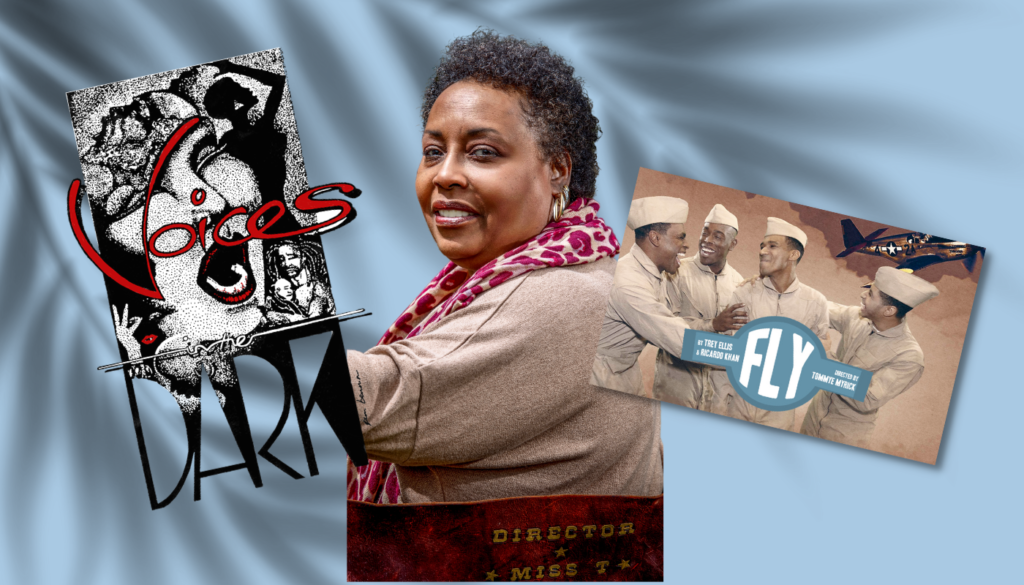
In 1992, she started her own theater production, Voices in the Dark Repertory Theatre Company. The production company was inspired by poems written by her friend and poet Sharon Bridgeforth. Myrick wanted to elevate the powerful messages honoring the struggle and success of African American women.
Myrick has produced more than 50 productions including “Code Noir.” She has received numerous awards, including several Big Easy Awards and nominations.
Most recently Myrick, 70, directed the play, “Fly” that was featured at the National World War II Museum. The play focused on the Tuskegee Airmen who were part of the more than 1.5 million Black men and women who served during World War II. Despite the fact that they were treated as second class citizens during the era of Jim Crow segregation, the men still fought for the country as dedicated military men.
Myrick talked with Verite about “Fly”, her vision and storytelling of African Americans and their lived experiences. She expressed the need for more Black stories to be told right in her hometown.
Q: In an interview with Xavier University, you said “Every play I have ever directed has some type of social justice message.” Why is that important to you?
A: I was raised in a time of segregation. I lived in Pontchartrain Park. I was raised in Treme, [which] is the oldest African American community in America, and with that comes pride. We got those second- and third- and fourth-hand books from those white schools after they done tore it up and wrote all over them.
When we got those books, our Black teachers would teach what they taught us in those books. Then they will push those books aside and say, “Now let me tell you about George Washington Carver,” and “know you know about Frederick Douglass, but let me tell you about Toussaint Louverture.”
Whether we are a dancer, swimmer, a skydiver, a pilot, a poet, a writer, or a painter, we rise, and that’s what “Fly” does. Then, in spite of it all, we rise and fly – and we flew and continued to soar.
Q: What inspired you to tell the story of the Tuskegee Airmen?
A: I am inspired to tell all stories of African Americans and African American heroes and sheroes whose stories have not been told or have been altered or deleted or swept under the carpet. That is my inspiration.
As a people, our survival will only come from standing on the shoulders of the heroes and sheroes who came before us. But if we don’t know that, there are no shoulders for us to stand on.

Q: In the media and in daily life, Black men are often portrayed as predators or violent. How did “Fly” show Black men in another light?
A: It’s called HIS-STORY for a reason — history. They say that history is written by the victor, and indeed it appears that it is, especially when it comes to African Americans’ contributions here in America.
At the time, the Tuskegee Airmen when they were recruited, there was no Air Force. It was called the U.S. Army Air Corps, and it was supposed to be a failed experiment, egged on by Eleanor Roosevelt. But it did not fail. As a matter of fact, it succeeded.
A stereotype was that we could not handle these big machines. That we could not maneuver or mentally calculate the strategic latitudes and longitudes as it relates to wind bombing. This was all blown to hell, and the play actually showed that. They were fighting on two fronts. They were fighting the war overseas and fighting racism here in the country.
Q: Why was it important for the play to be shown during Black History Month?
A: It’s important for this show to be shown every month. But the interesting thing about it is that here in New Orleans, where there is no Black-owned theater, we really have to wait until the white theaters say, “OK, we’re gonna do our one Black play this year.”
I can very well say, “I’m not doing a play this month.” What’s most important is that we utilize whatever it is we have to get the story out there.
Q: Can you tell me more about Voices in the Dark Repertory?
A. Voices in the Dark Repertory [started off] made up of all African American women. All the actors were women, the set designer, the light designer, the costume designer and the directors.
So our mission is to do plays and productions that will not normally be seen or heard. Plays [and stories] about alcoholism, homosexuality, transgender, drug addiction, and social injustice.

Q: As a Black woman director, how do your life experiences help your storytelling?
A: There are a lot of young writers and producers who are writing today, and they’re writing a lot about sci-fi stories, gangs, and battles. But someone has got to continue to tell the stories that have not been told.
So somebody’s got to tell the legacy stories. I was just talking to a very good friend of mine, Lance Nichols, and I said, “Lance, we need to create something that’s called the Legacy Series. Every year, we need to do at least one Black play from the past.”
https://www.nationalww2museum.org/events-programs/events/131337-fly